At the intersection of the mid-Hudson Valley and Catskills, we have a very varied climate. We have freezing winters, wet springs, and hot, humid summers. This means that a flexible and efficient heating and cooling system is a priority for local homeowners.
We’ve demonstrated in past blog posts about Columbia, Greene and Ulster County that homeowners are transitioning from heating oil to cleaner alternatives like natural gas, propane, and heat pumps. In this blog post, we’re going to focus on heat pumps, which move heat from one place to another.
In the winter, they extract warm air from your home and move it outside; in the winter, they pull heat from the outside air and transfer it indoors. They don’t generate heat, but they use electricity to move it. There are three main kinds of heat pumps, and in this blog post, we’re going to talk about each kind and their use case scenarios for Hudson Valley homeowners.
Air-Source Heat Pumps (Ducted)
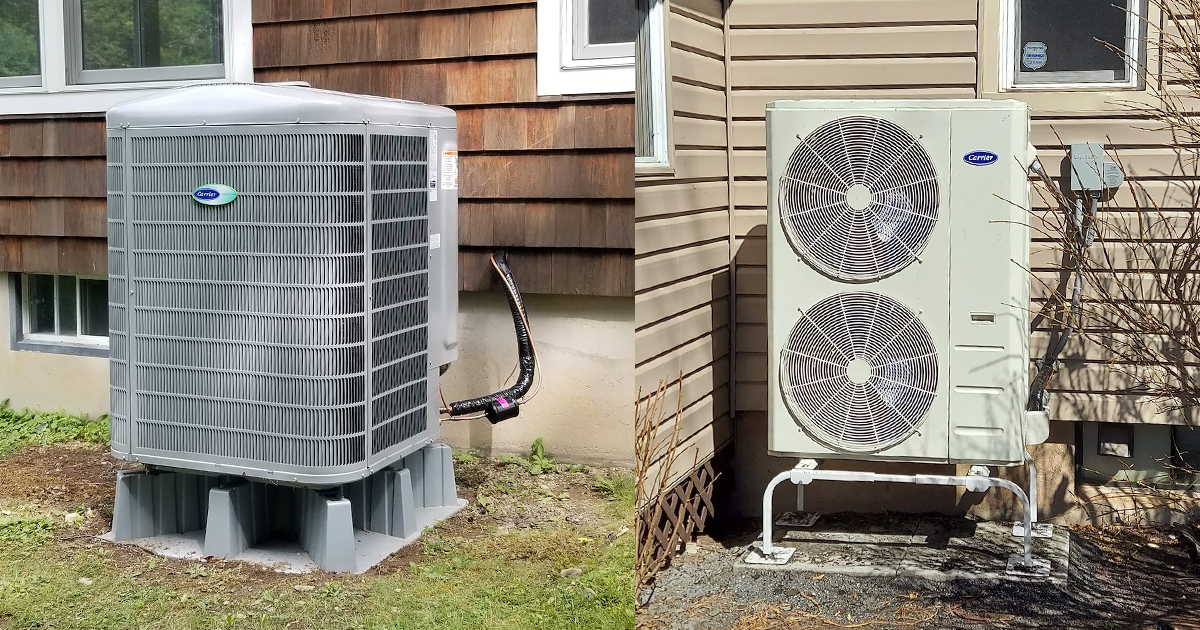
An air-source heat pump is a central, ducted system that can replace a traditional furnace and air conditioner combination. It has an outdoor condenser unit and an indoor coil/blower that connects to existing ductwork.
In the summer, it moves heat to the outside like a regular AC, and in the winter, it runs in reverse. Air-source heat pumps can operate in low outdoor temperatures, as there are now cold climate heat pumps that are specifically designed to remain efficient up to -5 degrees and lower.
The main strength of these heat pumps is that they leverage your home’s existing ductwork to distribute air, and they can replace your air conditioner and furnace with one system. However, if there is sustained extreme cold, you may have higher winter electric bills if you don’t have backup heat. Older homes may need an electrical upgrade to accommodate these heat pumps.
Since these provide whole-home heat and cooling, there’s less zoning flexibility; a single thermostat will control the whole house.
Ductless Mini-Split Heat Pumps
These are the most common kinds of heat pumps that we work with. Ductless mini-splits are air-source heat pumps that don’t require ducts to distribute air; instead, refrigerant lines run from a small outdoor condenser to one or more indoor compact units mounted on walls and ceilings in the rooms that you want to heat or cool.
Each indoor unit circulates air within its zone. Mini-splits can be installed as single-zone systems, with one indoor unit connected to one compressor, or multi-zone systems where multiple units are connected to one outdoor compressor.
The main strength of these is their flexibility and room-by-room control; since you’re not relying on ductwork, you can put a heat pump in different rooms and control the temperature independently. You won’t be wasting energy on an unoccupied room. They’re very efficient and easy to install.
The main drawback of them is that with several units in one home, that means that you have several units to maintain instead of one central compressor. The outdoor units are not hideous, but you may run into aesthetic concerns especially in the Hudson Valley’s historic districts. These can be addressed with good landscaping and screening. And again, if there is sustained extreme cold, you may want to have a backup source of heat ready to go.
Hybrid Heat Pump Systems (Dual-Fuel HVAC)
This option is rare, but makes sense in some situations. It combines an electric heat pump with a traditional gas, propane or oil furnace in one integrated setup. You’d have two heat sources; heat pumps for moderate heating needs (as well as cooling in the summer) and a furnace backup that carries the load during cold weather events.
The system is integrated so that it automatically switches between the heat pump and the furnace based on outdoor temperature or efficiency settings. The main drawback is that this costs more up front than just a standard furnace or standalone heat pump system. The complexity means that there are more things to maintain, and it will necessarily take up more space.
What’s Best For You?
If your home has existing ductwork and a relatively modern furnace, you may want to consider an air-source heat pump or a hybrid system.
If your home does not have ductwork, then a ductless mini-split heat pump system is your best bet. You avoid the headache and expense of adding ducts, and you can preserve your home’s character.
If you’re in a large, multi-story home with diverse heating needs, you may need multiple kinds of heat pumps. For example, some homes have ductwork downstairs where a central-air source heat pump will work, but then they have a tricky upstairs bonus room or new addition that requires a ductless mini-split. We can tailor a solution that fits every zone of your home.
Get solid advice from local pros who understand New York winters and the latest heat pump tech. Contact Precision HVAC today to schedule a free in-home evaluation. We’ll answer all your questions, provide a detailed quote (including any available rebates and financing options), and ultimately ensure you get the best heat pump for your Hudson Valley home. With the right system, you can look forward to cozy winters, cool summers, and lower energy bills for years to come.